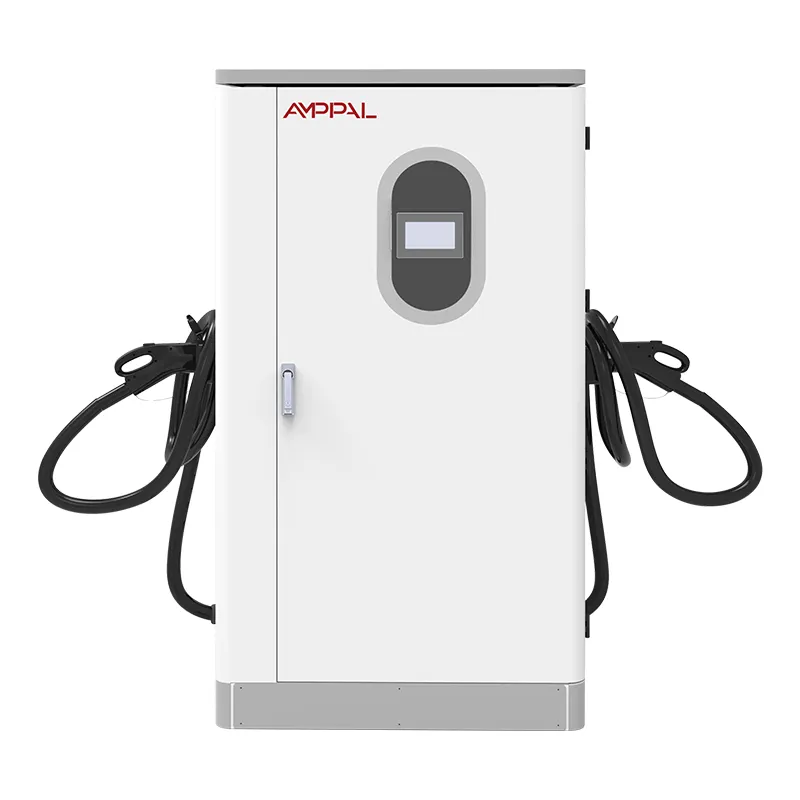
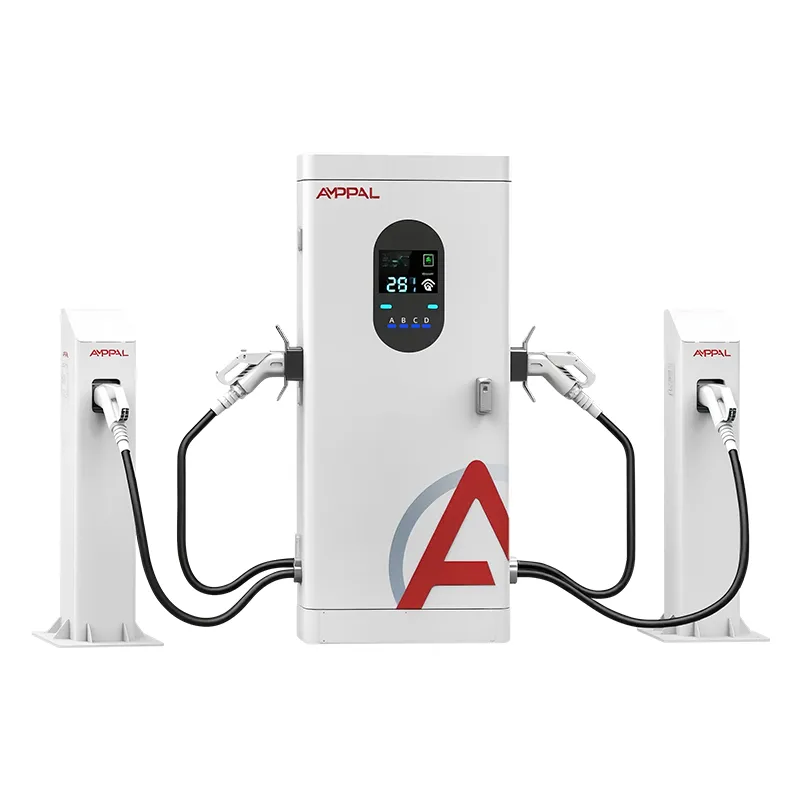
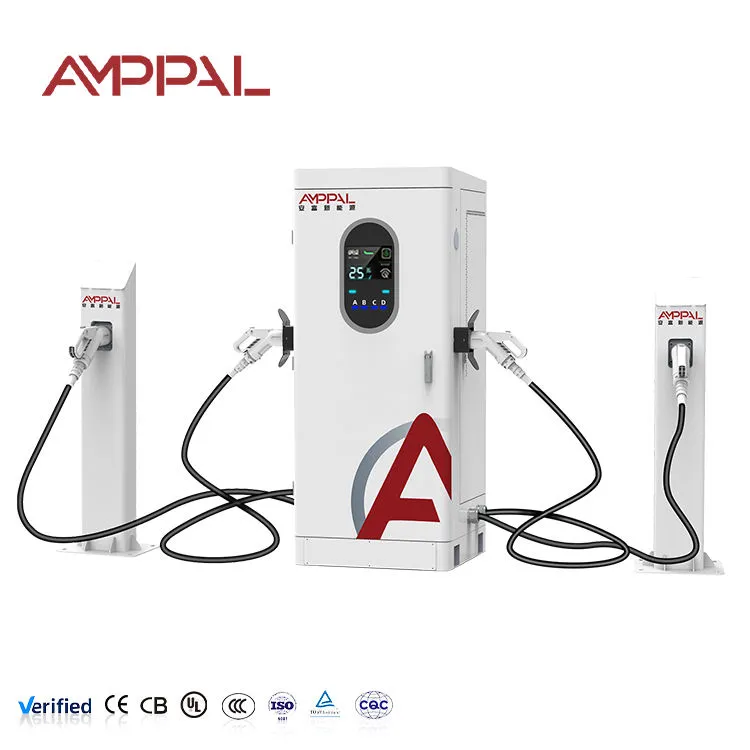
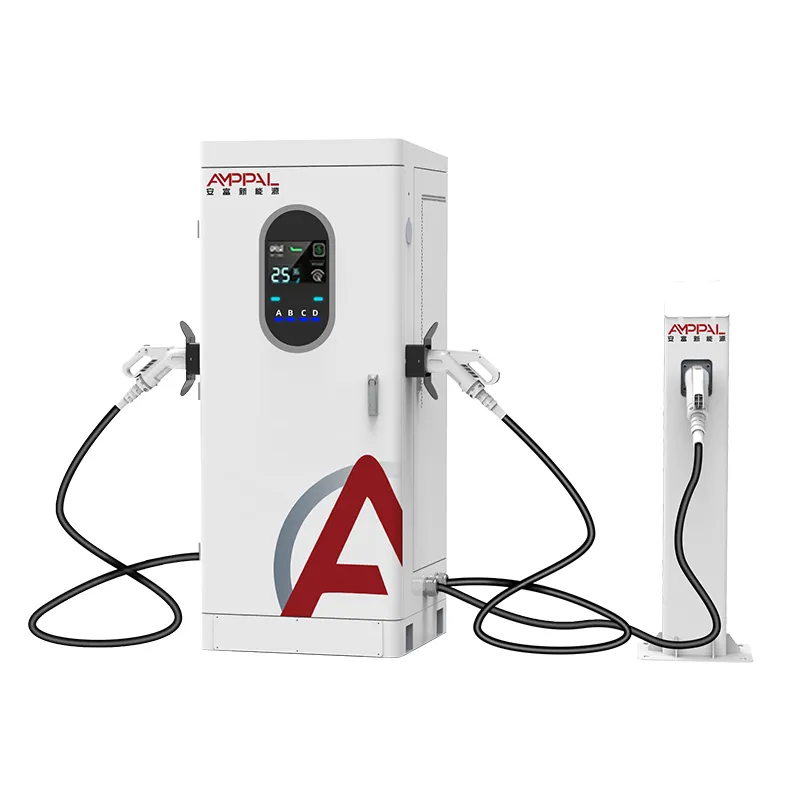
Fleet depots, highway corridor stations, and urban charging hubs all face the same underlying constraint: the local grid connection is finite, yet demand for fast charging continues to rise. Multi-Gun DC Chargers are a direct response to that constraint. Instead of installing several independent DC fast chargers, each requiring its own power conversion cabinet, circuit protection, and network drop, a multi-gun system centralizes power conversion and distributes DC output to multiple dispensers. This architecture reduces footprint, lowers installation cost, and enables more intelligent use of available grid capacity.
AMPPAL has focused its engineering effort on building multi-gun platforms that remain easy to service, simple to integrate, and flexible enough to support mixed EV fleets. The following technical overview explains the core parameters, model range, power management logic, connector options, and common operator questions.
What Makes a Multi-Gun DC Charger Different
A conventional DC fast charger has one power cabinet and one dispenser with one or two cables that serve a single parking bay. A multi-gun DC charger uses one central power cabinet and multiple remote or integrated dispensers, each with its own charging connector. The central cabinet contains stackable power modules that convert AC grid power to DC. The system then routes DC power to whichever dispensers are in use. This means a single site can serve two, three, or four vehicles at once without duplicating the entire power conversion chain.
For charging operators, the difference shows up in capital expenditure and operating cost. Fewer cabinets mean less concrete work, fewer trenching runs, fewer switchgear connections, and fewer points of failure. Power modules inside the cabinet can be shared across connectors, so when one vehicle slows its charging rate, the released capacity is reassigned to another connector. That dynamic utilization is difficult to achieve with fully independent chargers.
Core Electrical and Mechanical Parameters
The specification sheet for a multi-gun DC charger should be read as a system-level document, not just a single charger rating. AMPPAL publishes the following parameters for its current multi-gun lineup. Values apply to standard configurations; regional grid requirements may affect input voltage and frequency.
-
Grid input options: 480 VAC ±10%, 3-phase, 60 Hz for North American sites; 400 VAC ±10%, 3-phase, 50 Hz for European and Asian sites; 208 VAC input available on select 60 kW models
-
Output voltage range: 150–1000 VDC, supporting both 400 V and 800 V battery architectures without external converters
-
Maximum output power: 60 kW, 120 kW, 240 kW, and 360 kW per central cabinet, scalable to 480 kW on the MG180 platform with additional power modules
-
Number of charging guns: 2, 3, or 4 per system depending on cabinet model and dispenser configuration
-
Continuous current per gun: 150 A to 250 A with air-cooled cables; up to 500 A with liquid-cooled cable assemblies on the MG180-4
-
Power module efficiency: ≥95% at nominal load and ≥94% across a 20–100% load window
-
Power factor: ≥0.99 at full rated output
-
Total harmonic distortion: ≤5% at full load, meeting IEEE 519 requirements
-
Standby power consumption: ≤25 W per inactive dispenser
-
Operating temperature range: -35°C to 60°C; output derating begins at 50°C ambient for air-cooled configurations
-
Storage temperature range: -40°C to 70°C
-
Humidity: 5% to 95% non-condensing
-
Altitude: rated to 2,000 m without derating; high-altitude versions available to 4,000 m
-
Enclosure protection: IP55 for the central power cabinet, IP54 for dispensers, optional IP65 for coastal or high-dust sites
-
Cooling method: forced air for power cabinet; forced air or liquid cooling for dispenser cables depending on current rating
-
Connector standards: CCS1, CCS2, CHAdeMO, and GB/T, configurable per gun at time of order
-
Communication protocols: OCPP 1.6J, OCPP 2.0.1, Modbus TCP, Ethernet, 4G LTE, and Wi-Fi
-
Authentication methods: RFID ISO 14443A/B, ISO 15693, QR code, and ISO 15118 plug-and-charge
-
Safety certifications: UL 2202, UL 2594, CSA C22.2 No. 346, CE, IEC 61851-1, IEC 61851-23, and ISO 15118
-
Surge protection: Type 2 AC and DC surge protective devices, with optional Type 1+2 for lightning-prone regions
-
Ground fault protection: integrated AC/DC residual current monitoring with automatic reset and event logging
These parameters reflect the complete system rather than a single charging port. Operators should pay particular attention to the output voltage range and current limits, because those values determine real-world session speed for different EV models.
AMPPAL Multi-Gun DC Charger Model Range
The AMPPAL product line is organized by maximum cabinet output and the number of dispensers connected. The table below summarizes standard configurations. Custom gun mixes and connector types are available for large fleet deployments.
|
Model
|
Max Output Power
|
Number of Guns
|
Continuous Current per Gun
|
Input Voltage
|
Enclosure Rating
|
Dimensions (W×D×H)
|
Operating Temperature
|
|
MG30-2
|
60 kW
|
2
|
150 A
|
480 VAC / 400 VAC
|
IP55 / IP54
|
700×600×1850 mm
|
-30°C to 55°C
|
|
MG60-3
|
120 kW
|
3
|
200 A
|
480 VAC / 400 VAC
|
IP55 / IP54
|
800×700×1950 mm
|
-30°C to 55°C
|
|
MG120-4
|
240 kW
|
4
|
250 A
|
480 VAC / 400 VAC
|
IP55 / IP54
|
1,200×800×2,000 mm
|
-35°C to 60°C
|
|
MG180-4
|
360 kW
|
4
|
500 A with liquid cooling
|
480 VAC / 400 VAC
|
IP55 / IP65 optional
|
1,400×900×2,100 mm
|
-35°C to 60°C
|
Each model uses the same modular power stage, so a 120 kW cabinet can be upgraded in the field by installing additional 30 kW or 40 kW modules. That modularity also simplifies spare parts inventory for operators who manage multiple AMPPAL sites.
Dynamic Power Sharing and Load Management
The most important software feature in a multi-gun DC charger is dynamic power sharing. Fixed power splitting divides the cabinet rating equally among connectors, which wastes capacity when one or more vehicles reduce their charge rate. Dynamic power sharing continuously reads each vehicle's requested voltage and current, then reallocates available DC capacity in real time.
In an AMPPAL system, the central controller samples each connected vehicle at 100 ms intervals. If a vehicle enters constant-voltage mode and begins tapering its current draw, the controller releases the unused capacity to other active sessions. This is especially valuable in fleet depots where different EV models with different battery voltages charge side by side. A 240 kW AMPPAL MG120-4 can deliver the full 240 kW to a single connector when the other three are idle, or split it intelligently across four vehicles as demand changes.
The system also supports scheduled power limits and demand response integration. Operators can cap total site power during peak utility rate windows, or allow the charger to reduce load automatically when the building management system sends a demand response signal. This capability helps avoid expensive demand charges and keeps the charging site within grid connection limits.
Connector Compatibility and Cable Cooling
Multi-gun DC chargers are only as useful as their connector mix. AMPPAL builds each gun to order with CCS1, CCS2, CHAdeMO, or GB/T connectors. In North America, the most common configuration is CCS1 for light-duty vehicles plus optional CHAdeMO for legacy models. European and Asia-Pacific operators often choose CCS2 only or a mix of CCS2 and CHAdeMO. GB/T configurations are available for markets that require them.
Cable cooling has become a critical variable as automakers push pack voltages to 800 V and charge rates toward 350 kW. Air-cooled cables are lighter and simpler to maintain but become thick and heavy above 200 A continuous. Liquid-cooled cable assemblies allow continuous currents up to 500 A while keeping the cable diameter manageable. AMPPAL offers liquid-cooled dispensers on the MG180-4 and as an optional upgrade on lower-power models where future-proofing is a concern.
Each dispenser is available with an integrated cable management system, including retractable cable suspension or swing-arm mounting. This reduces cable wear and keeps the charging bay clear for drivers.
Network Integration and OCPP Compliance
Charging networks require reliable communication between the charger and the central management system. AMPPAL multi-gun DC chargers support OCPP 1.6J and OCPP 2.0.1, which means they can connect to most major charging network management platforms without custom middleware. OCPP 2.0.1 adds improved security profiles, smart charging commands, and transaction data handling that make large fleets easier to manage.
The chargers also provide Modbus TCP for integration with local energy management systems. In a depot where solar generation, battery storage, and building load are managed together, Modbus allows the charger to receive real-time power setpoints from the site controller. The system can reduce output when solar production drops or when storage discharges at its programmed limit. That level of integration is difficult to achieve with chargers that only expose OCPP and no local protocol.
Safety, Compliance, and Environmental Ratings
DC fast charging hardware operates at high voltage and high current, so safety compliance is non-negotiable. AMPPAL multi-gun DC chargers carry UL 2202 and UL 2594 certification for the North American market, CSA C22.2 No. 346 for Canada, and CE marking under IEC 61851-1 and IEC 61851-23 for Europe. The ISO 15118 compliance path enables plug-and-charge authentication, which reduces the number of steps a driver must take to start a session.
The enclosures are designed for outdoor installation in variable climates. IP55 on the power cabinet protects against dust and low-pressure water jets from any direction. Optional IP65 dispensers add protection for coastal sites where salt spray is common. The operating temperature range of -35°C to 60°C covers most deployment scenarios, with heater and fan control logic that prevents condensation inside the enclosure during rapid temperature changes.
Application Scenarios for Multi-Gun DC Chargers
Fleet depots are the clearest fit for multi-gun architecture. Delivery vans, school buses, and municipal service vehicles often return to the depot at similar times and need rapid turnaround. A four-gun system lets multiple vehicles charge overnight or during a short layover without requiring each parking bay to have its own full power cabinet. The central controller can also prioritize specific vehicles based on departure schedules.
Public fast-charging corridors benefit from the same hardware. Highway rest stops and fuel stations often have limited electrical capacity. A 360 kW cabinet feeding four dispensers means four drivers can start charging immediately, even if total site power is lower than the sum of four independent chargers would require. The dynamic power sharing software prevents long queues and improves the overall experience for drivers who arrive with different states of charge.
Workplace and retail locations can use smaller multi-gun systems to offer DC fast charging without the cost of installing a full-size public station. An AMPPAL MG30-2 can serve two parking spaces while keeping installation costs manageable for property owners. Because the system is modular, the owner can add capacity later as employee EV adoption grows.
Installation and Site Requirements
Installing a multi-gun DC charger requires more planning than a single-port unit, but the total site cost is often lower per charging bay. The central power cabinet should be placed as close as possible to the main switchgear to reduce AC feeder cost. Dispensers can be installed up to 50 m from the cabinet using DC power cables, subject to cable size and voltage drop calculations. AMPPAL provides a site planning tool that calculates cable gauge, trench depth, and thermal derating based on the expected load profile.
Each parking bay should have a concrete pad or asphalt surface rated for the dispenser weight and cable management system. Bollards or wheel stops are recommended to prevent vehicle impact. The cabinet requires a minimum clearance of 800 mm on all service-access sides and 1,000 mm in front of the door. The units are designed for through-the-bottom or rear cable entry, which keeps conduits out of sight and reduces trip hazards.
Maintenance and Serviceability
AMPPAL multi-gun DC chargers are built with front-access service panels and modular power modules that can be replaced by a single technician using standard tools. The most common maintenance items are air filter replacement, cable inspection, connector pin wear checks, and firmware updates. Liquid-cooled systems require coolant level and pump checks at intervals recommended in the service manual.
The charger controller logs all fault events, temperature data, and energy delivery metrics locally and can push them to the network management system. That data helps maintenance teams diagnose problems remotely before dispatching a technician. Most faults can be resolved remotely through OCPP commands or by restarting an individual power module, which reduces site down time.
Frequently Asked Questions
Q: Can two or more vehicles charge at full speed at the same time on one AMPPAL multi-gun DC charger?
A: It depends on the cabinet rating and the vehicles' charge requests. The system can deliver its maximum output to one gun when the others are idle. When multiple vehicles are connected, available power is shared dynamically. For example, a 240 kW model can charge one vehicle at 240 kW, two vehicles at 120 kW each, or four vehicles at 60 kW each if all request equal power. If one vehicle tapers to 40 kW, the controller immediately reassigns the released 20 kW to another active session. This means vehicles rarely charge at their individual maximum when the cabinet is fully occupied, but the site as a whole uses grid capacity much more efficiently than independent chargers would.
Q: What is the difference between dynamic power sharing and fixed power splitting?
A: Fixed power splitting divides the cabinet capacity equally among connectors, regardless of whether each vehicle can use it. Dynamic power sharing measures each vehicle's real-time request and battery voltage, then distributes capacity accordingly. In an AMPPAL system, the controller samples every connected vehicle at 100 ms intervals. If a vehicle reduces its current draw during the constant-voltage phase, that capacity is shifted to another connector. Dynamic sharing is the only approach that maximizes connector utilization and reduces average session time without requiring a larger grid connection.
Q: Are AMPPAL multi-gun DC chargers compatible with both 400 V and 800 V electric vehicles?
A: Yes. All AMPPAL multi-gun DC charger models output a voltage range of 150–1000 VDC. The charger automatically detects the vehicle battery voltage and adjusts the DC output to match. This means a 400 V Tesla Model 3 and an 800 V Hyundai Ioniq 5 can charge on the same unit, on different guns, at the same time. The system does not require an external booster or separate charging modules for high-voltage platforms.
Q: How many dispensers can be connected to one AMPPAL central power cabinet?
A: Standard configurations support two, three, or four dispensing guns per cabinet. The MG30-2 and MG60-3 are designed for compact sites with two or three parking bays. The MG120-4 and MG180-4 support four guns and are intended for larger depots or public fast-charging hubs. Where additional bays are needed, multiple central cabinets can share a common DC bus or be managed as a group by the same site controller. AMPPAL also offers satellite dispenser options that extend charging bays farther from the power cabinet for drive-through layouts.
Q: What maintenance does a multi-gun DC charger require?
A: Most AMPPAL multi-gun DC chargers require four routine service actions: air filter cleaning or replacement every six to twelve months depending on dust exposure, visual inspection of cables and connectors every three months, firmware updates as released, and an annual torque check on electrical terminations. Liquid-cooled models add a coolant level and pump check at least twice per year. The system logs temperature and fault data continuously, so many issues can be diagnosed remotely before a technician is dispatched. Because power modules are hot-swappable, a module replacement typically takes less than 30 minutes and does not require shutting down other guns.
Q: Can the charging capacity be increased after the system is installed?
A: Yes. AMPPAL multi-gun DC chargers use a modular power stage, so a 60 kW cabinet can be upgraded to 120 kW, a 120 kW cabinet to 240 kW, and a 240 kW cabinet to 360 kW by adding power modules. The field upgrade requires a service technician and a firmware update. In some cases, the AC feeder and circuit protection must be upsized to supply the higher power, so the upgrade should be planned with the original site electrical design. The modular architecture protects the initial investment and lets operators scale charging capacity as EV traffic grows.



 Whatsapp